Curious about Breathwork?
Sometimes talking about how you feel only gets you so far.
You can understand why you're stressed. You can know you need to slow down. You can even know exactly where certain patterns come from and still feel them in your body.
The racing mind. The tight chest. The constant tension. Feeling overwhelmed by small things. Struggling to switch off. Or sometimes feeling disconnected, flat or stuck.
Breathwork gives us another way in.
By consciously changing the way you breathe, we can influence your physiology and nervous system, creating space to experience and process what is happening beneath the constant thinking.
At Anchor Point, I use trauma-informed Conscious Connected Breathwork (CCB) alongside gentler breathing and grounding practices, depending on what you need.
What can breathwork help with?
People come to breathwork for lots of different reasons. You don't need to have experienced trauma or be going through a crisis to benefit from it.
You might simply feel like you need to get out of your head and reconnect with yourself.
Breathwork may support you if you're experiencing:
Stress, anxiety or feeling constantly "on"
Overthinking and difficulty switching off
Emotional overwhelm
Feeling stuck or disconnected from yourself
Built-up tension in the body
Difficulty accessing or expressing emotions
Burnout or mental exhaustion
Difficulty slowing down and resting
Repeating patterns you understand intellectually but struggle to shift
A desire for greater self-awareness and connection
A need for space to process something you've been carrying
Some people leave a session feeling lighter and calmer. Others experience clarity around something they've been struggling with. Some have an emotional release. Others simply feel deeply rested and connected to themselves.
There isn't a particular experience you're supposed to have.
What actually is breathwork?
Breathwork is the intentional use of breathing to influence how we feel physically, mentally and emotionally.
Breathing normally happens automatically, but it's also one of the few bodily processes we can consciously change.
Different breathing patterns have different effects.
Slow, gentle breathing can be used to support relaxation and down-regulation.
More active breathing can increase physiological arousal and create a very different experience.
Conscious Connected Breathwork is an active form of breathwork where the inhale and exhale are connected without a pause between them.
Rather than simply being a relaxation exercise, CCB can create a powerful physical and emotional experience.
Why does changing your breathing change how you feel?
Your breathing and nervous system are constantly communicating with one another.
Think about what happens naturally when you're frightened, relaxed, crying, exercising or sleeping, your breathing changes without you consciously deciding to change it.
We can also work in the opposite direction.
Change the breath, and you change signals within the body.
During Conscious Connected Breathwork, breathing more deeply and continuously changes the balance of oxygen and carbon dioxide in the body.
CO₂ levels can temporarily fall. This changes blood pH and can affect blood flow, nerve signalling and muscle activity.
That's why during a session you may experience very real physical sensations such as tingling, temperature changes, light-headedness or tightening in the hands.
At the same time, the combination of sustained breathing, focused attention, music and a safe environment can shift your normal state of awareness.
For many people, this creates an opportunity to step outside their usual stream of thinking and pay attention to sensations, emotions, memories or insights that might normally be difficult to access.
What does a breathwork session feel like?
This is probably the hardest question to answer because every session can be completely different.
You may experience:
Physically:
Tingling, warmth or cold, light-headedness, trembling, changes in sensation or temporary tightening/cramping in the hands or around the mouth, sometimes known as tetany.
These sensations can occur because of the temporary physiological changes created by the breathing pattern.
Emotionally:
Emotions can sometimes become more accessible during the breath.
That might look like crying, laughing, anger, joy, sadness or simply becoming aware of something you've been holding onto.
And sometimes nothing dramatic happens at all.
That's completely okay.
Mentally:
The beginning can feel surprisingly active.
Your mind might tell you:
"This is weird."
"I can't do this."
"How long is left?"
As you settle into the breathing, that constant mental commentary can become quieter.
Some people describe reaching a dream-like, meditative or altered state of awareness where thoughts, memories, imagery or insights arise differently than they normally would.
Afterwards:
This is where integration becomes important.
You may feel deeply relaxed, emotional, energised, clear-headed or simply tired.
We don't rush to interpret everything that happened.
Instead, there is space to come back into your body, rest, reflect and allow your experience to settle.
You are always in control
This is one of the most important things to understand about my sessions.
I don't force you through the breath.
You can slow down at any point.
You can return to normal breathing.
You can breathe through your nose.
You can stop.
There is no prize for breathing harder or having the biggest emotional release.
My role isn't to create an experience for you. It's to create enough safety for you to explore your own experience.
That's also what trauma-informed breathwork means to me: choice, consent, pacing and meeting you where you are.
What happens in a session?
We don't arrive and immediately start breathing.
We talk
We start with a conversation about how you're feeling, why you've come and anything you'd like support with. I'll also explain the practice, answer your questions and make sure breathwork is appropriate for you.
We ground
Before activating the nervous system, we first establish a sense of safety. We'll use gentle breathing, grounding and meditation to help you arrive in the room and connect with your body.
I teach you the breath
You'll learn the breathing pattern before we begin so you know exactly what you're doing. I'll also explain some of the sensations you might experience so nothing comes as a surprise.
We set an intention
You may choose something you'd like to explore, release or understand. Or your intention can simply be: "I'm open to whatever I need today."
We breathe
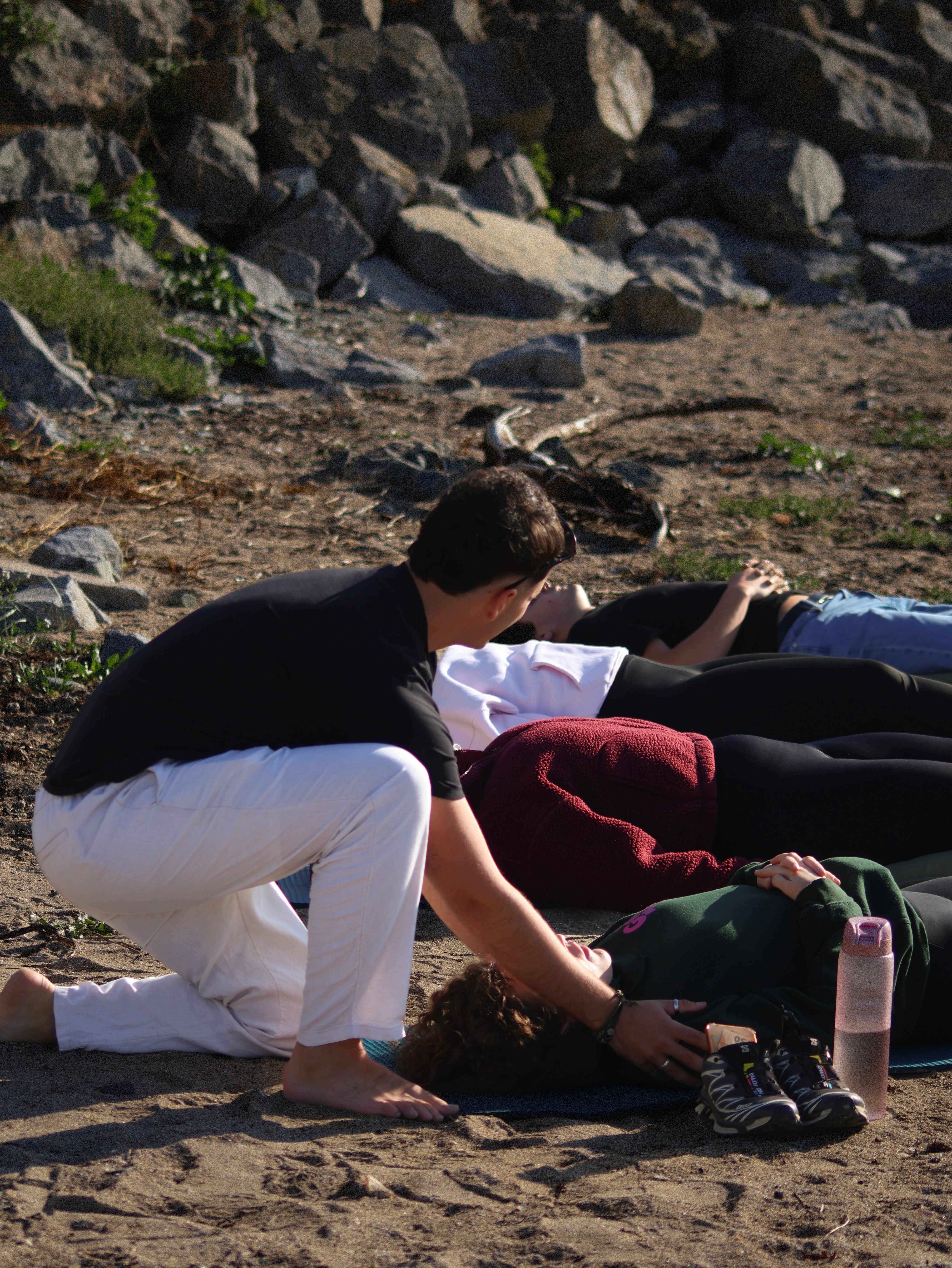
You'll lie comfortably on a mat while I guide you through the practice. Music is used throughout the session and I remain there with you, supporting and guiding the breath while continually responding to how you're doing.
We come back down
The active breathing ends gradually. You'll return to natural breathing and have time to rest while your nervous system settles.
Integration
We finish with time to reflect on your experience. There is no pressure to immediately make sense of everything. Sometimes the meaning of a session becomes clearer afterwards.
Breathwork isn't about being calm all the time
A healthy nervous system isn't one that stays relaxed 24/7.
We need activation.
We need energy.
We need the ability to respond to challenge.
And we also need the ability to come back down afterwards.
Think of it more like a pendulum.
Your nervous system naturally moves between activation and rest. Breathwork can be used on both sides, gentle breathing practices to support settling and recovery, and more activating practices such as Conscious Connected Breathwork to intentionally explore heightened states.
The goal isn't to never become stressed.
It's to build greater flexibility in how you respond and recover.
Is breathwork safe for everyone?
Gentle breathing practices can be adapted for most people, but Conscious Connected Breathwork is a more intense practice and isn't appropriate for everyone.
Because it intentionally changes breathing patterns and can create significant physiological and emotional effects, I screen everyone before participating.
CCB may not be appropriate if you are pregnant or have certain cardiovascular conditions, uncontrolled high blood pressure, epilepsy/seizure disorders, significant respiratory conditions, recent surgery, certain eye conditions or some serious psychiatric conditions.
If anything comes up during screening, we can discuss whether a gentler form of breathwork would be more suitable or whether medical clearance is needed before taking part.
Your safety always comes before the experience.
Curious about experiencing it for yourself?
Explore upcoming group sessions or book a 1:1 breathwork session with Anchor Point below.